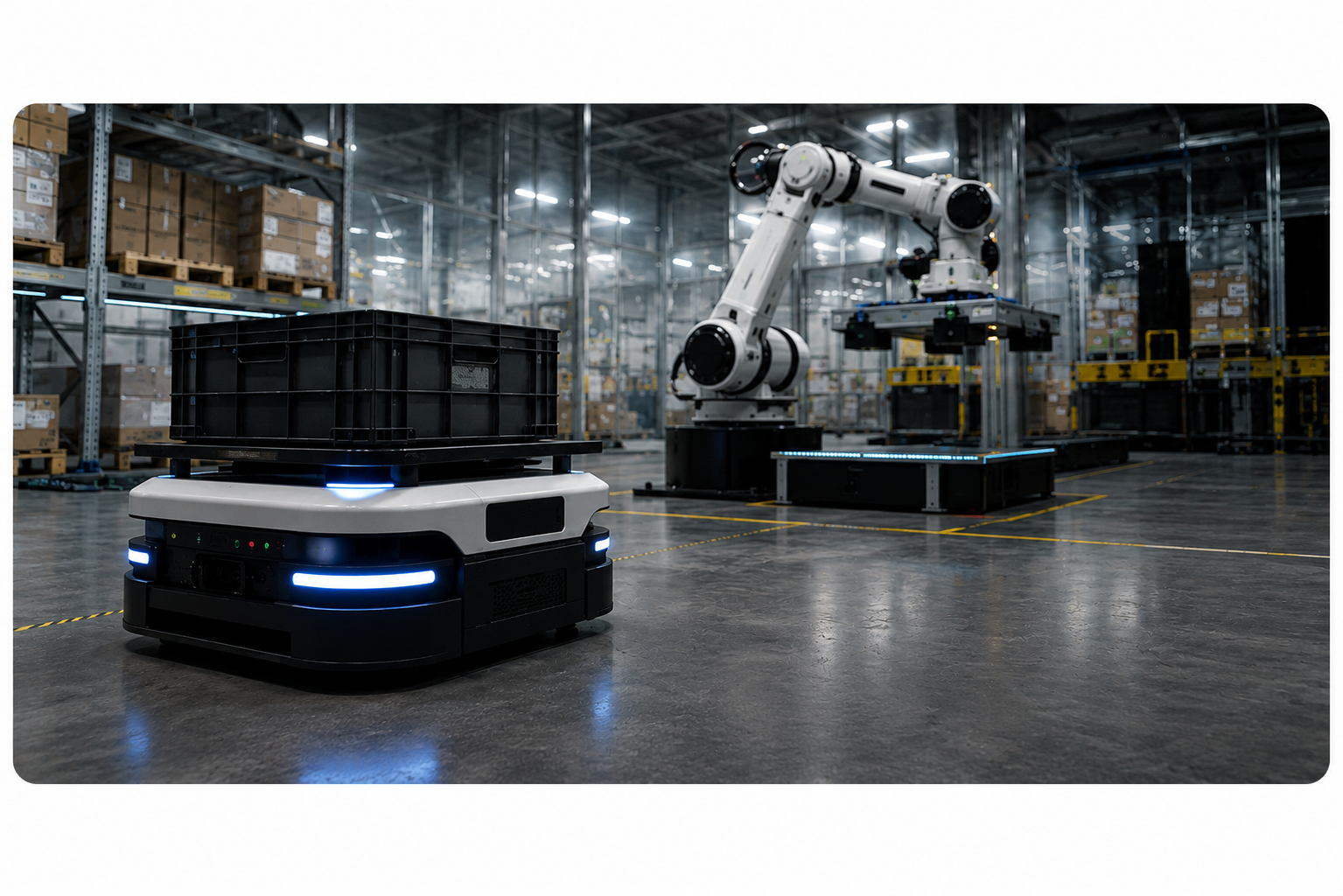
Artificial intelligence has largely been experienced through digital systems: recommendations, predictions, generated content, analytics and software assistants. Physical AI extends intelligence into systems that perceive, reason about and interact with the physical world.
When intelligence is connected to robots, autonomous machines, vehicles and other physical systems, the engineering problem changes. An output is no longer only text, an image or a prediction. It may influence movement, manipulation, navigation, machine behavior or another real-world action.
This creates a continuous relationship between perception, reasoning and physical action.
PHYSICAL ENVIRONMENT -\> PERCEPTION -\> UNDERSTANDING -\> REASONING / PLANNING -\> ACTION -\> PHYSICAL ENVIRONMENT
AI Is Moving Into the Physical World
Traditional digital AI generally receives data and produces a digital result. Physical AI operates as part of a system that is connected to a changing physical environment.
A robot may need to recognize an object, estimate its position, plan a safe movement and manipulate it. An autonomous mobile machine may need to understand free space, obstacles and its own position before deciding how to move. An intelligent vehicle may need to interpret surrounding conditions and support an appropriate system response.
In each case, intelligence is not isolated from the physical system. It participates in a closed loop between the environment and the machine.
What Is Physical AI?
Physical AI can be understood as artificial intelligence integrated into systems that perceive and interact with the physical world. It combines AI with sensing, computing, planning, control and physical hardware.
It is therefore more than simply adding an AI model to a robot.
Physical Environment
   ↓
Perception
   ↓
Understanding
   ↓
Reasoning / Planning
   ↓
Control
   ↓
Physical Action
   ↓
Physical Environment
The exact architecture varies by application, but the defining characteristic is that intelligence participates in understanding and influencing a physical system or environment.
Perception Comes First
A physical system cannot make useful decisions about its environment without information about what is happening around it.
Depending on the application, perception may use:
- Cameras and computer vision
- Depth sensing
- LiDAR and radar
- Position and motion sensors
- Force and torque sensing
- Proximity sensors
- Audio
- Machine and system telemetry
- Multiple sensors combined through sensor fusion
Perception converts physical signals into representations that software can use: objects, locations, motion, operating states, obstacles, anomalies or other contextual information.
The quality of physical intelligence is therefore strongly connected to the quality of its perception.
From Perception to Reasoning and Planning
Recognizing what exists in an environment is different from deciding how to interact with it.
A physical system may need to answer questions such as:
- Where am I?
- What objects or people are around me?
- What is changing?
- What is the goal?
- What actions are possible?
- Which action is appropriate?
- Can the action be executed safely?
Reasoning and planning connect perception with action. Depending on the system, this layer may involve learned models, planning algorithms, optimization, rules, domain logic or combinations of these techniques.
For a mobile robot, the result may be a path. For a manipulation system, it may be a sequence of movements. For an intelligent machine, it may be a change in operating behavior or a request for human intervention.
When Intelligence Becomes Action
Physical action introduces consequences that purely digital outputs do not have. A generated sentence can be regenerated. A physical movement occurs in a real environment with geometry, friction, uncertainty, people, equipment and other constraints.
Actions may include:
- Moving a robot or autonomous machine
- Manipulating or positioning an object
- Changing machine operation
- Triggering an actuator
- Supporting a vehicle-system response
- Adjusting an environment
- Stopping, slowing or requesting human intervention
This is why physical AI requires close integration between intelligence and traditional engineering disciplines such as embedded systems, control, sensing, robotics, safety and validation.
Physical AI Across Real-World Systems
| Environment \| Intelligence Role \| Physical Outcome \|
| --- \| --- \| --- \|
| Manufacturing & Industrial Robotics \| Perception, inspection, operator decision \|
| Autonomous Mobile Robots \| Localization, environment understanding
| Intelligent Mobility \| Perception and interpretation of \|
| Warehousing & Logistics \| Object, inventory and environment
| Smart Environments \| Occupancy, safety and environmental intelligence
Simulation Meets the Real World
Developing physical AI directly in the real world can be expensive, slow or difficult to reproduce. Simulation can provide controlled environments for development, experimentation and testing.
In simulation, engineers can vary environments, objects, sensor conditions and operating scenarios without repeatedly modifying physical hardware. Simulation can also support testing of situations that are difficult to reproduce consistently in a real environment.
But simulation does not remove the need for real-world validation.
Real sensors contain noise. Lighting changes. Materials behave differently. Mechanical systems have tolerances. Surfaces, people and environments vary. Communication and compute performance can change under operating conditions.
The transition from simulated performance to reliable physical operation is therefore a significant systems-engineering challenge.
Physical AI Is a Systems Problem
The AI model is only one layer of a physical AI system.
Sensors -\> Perception -\> AI / Reasoning -\> Planning -\> Control -\> Actuators -\> Physical System
Around that core loop are additional engineering concerns:
- Embedded and edge computing
- Real-time performance
- Power and thermal constraints
- Connectivity
- Mechanical and electrical integration
- Reliability
- Safety
- Cybersecurity
- System monitoring
- Testing and validation
- Lifecycle and update management
A highly capable model cannot compensate for unreliable sensing, unsuitable compute hardware, poor control integration or inadequate validation.
Physical AI should therefore be engineered as a complete system rather than treated as an isolated AI feature.
Edge Intelligence and Physical AI
Many physical AI applications also depend on edge computing because perception, planning or control may need to operate close to the physical system.
A robot cannot assume that every immediate decision will be processed by a distant cloud service. Vehicles, industrial machines and autonomous systems may also need local capabilities for latency, resilience, bandwidth or operational reasons.
At the same time, cloud or centralized platforms can support model lifecycle management, fleet monitoring, historical analysis, coordination and other functions that benefit from broader visibility.
Physical AI therefore often becomes a distributed architecture spanning sensors, edge compute, intelligent software, cloud platforms and the physical machine itself.
Autonomy Is a Spectrum
Physical AI does not automatically mean complete autonomy.
Systems can operate at different levels of human involvement:
- AI provides information to a human operator
- AI recommends an action and a human approves it
- AI performs selected tasks autonomously while a human supervises
- AI performs broader autonomous functions within defined operating
boundaries
The appropriate level depends on the application, risk, maturity of the technology, operating environment and system requirements.
In many real-world applications, the most useful architecture may combine machine intelligence with human judgment rather than attempting to remove people from every decision.
From Software Intelligence to Embodied Action
Physical AI expands the role of artificial intelligence from interpreting digital information to participating in the operation of real-world systems.
It brings together perception, reasoning, planning, embedded computing, control and physical hardware.
The opportunity spans robots, vehicles, industrial systems, autonomous machines and intelligent environments. But realizing that opportunity requires more than increasingly capable AI models.
Systems must perceive reliably, make appropriate decisions, operate within physical constraints and translate intelligence into dependable action.
SENSE
UNDERSTAND
DECIDE
ACT
When that loop reaches beyond software and closes through the physical world, AI becomes part of the machine, vehicle, robot or environment itself.
That is the direction of Physical AI - and a fundamental part of Intelligence for the Physical World.