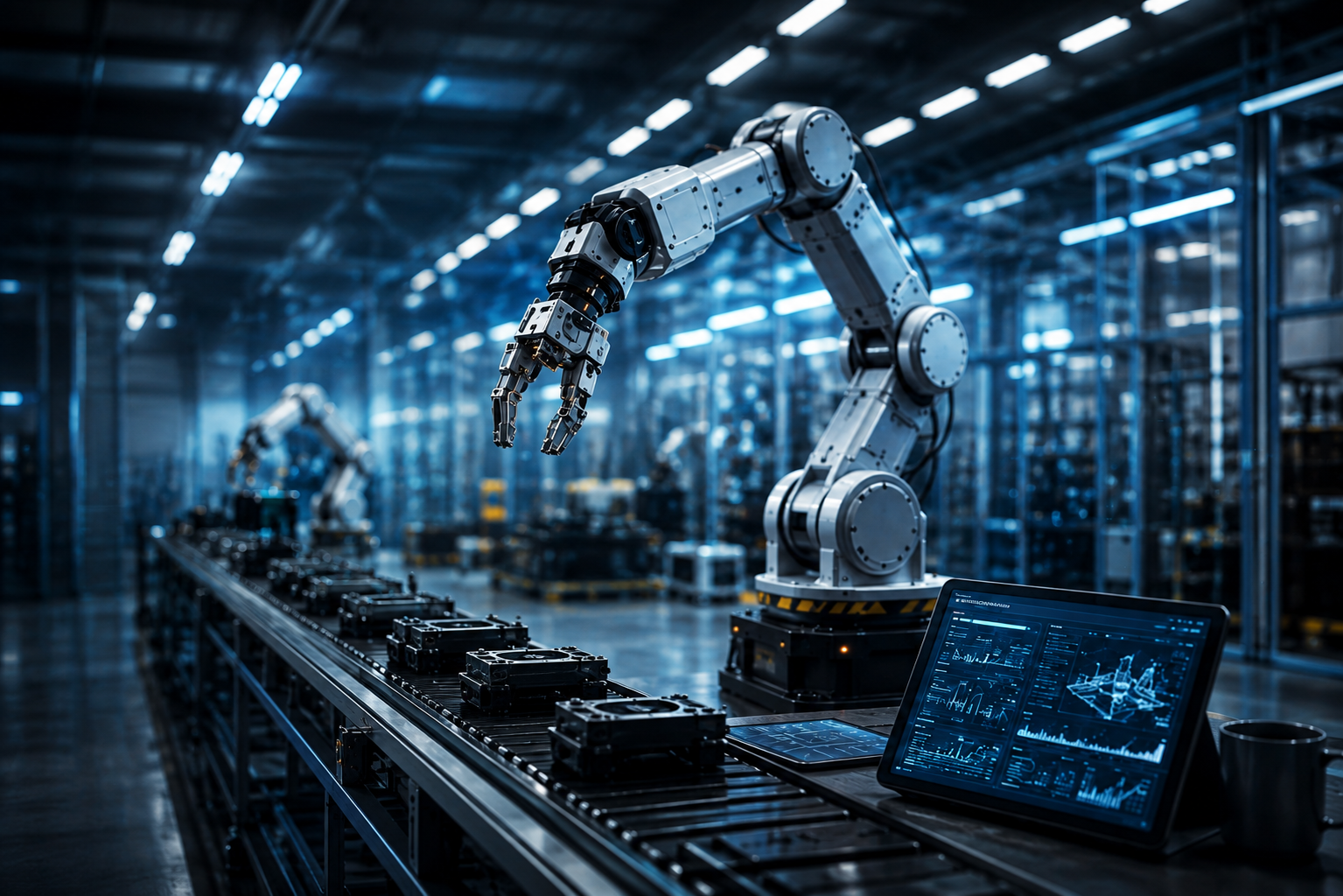
Artificial intelligence is moving beyond purely digital experiences. Increasingly, intelligence is being connected to machines, vehicles, robots, cameras, sensors and physical environments.
In these systems, generating an AI prediction is only part of the problem. The larger engineering challenge is creating a complete loop that can observe the physical world, interpret what is happening, determine an appropriate response and translate that decision into action.
SENSE -\> UNDERSTAND -\> DECIDE -\> ACT
This pattern provides a common foundation for intelligent systems across manufacturing, mobility, robotics and smart environments.
From Digital Intelligence to Physical Intelligence
Many conventional AI applications operate primarily within a digital environment:
Data -\> AI Model -\> Digital Output
A recommendation engine produces a recommendation. A language model generates text. An analytics system produces an insight.
Physical-world intelligence extends that relationship:
Physical World -\> Sense -\> Understand -\> Decide -\> Act -\> Physical World
The system is no longer working only with digital information. It is connected to real machines, objects, people and environments.
That changes the engineering problem significantly.
01 - Sense
Capturing the Physical World
Every intelligent physical system needs a way to observe its environment.
Depending on the application, that information might come from:
- Cameras and video
- LiDAR and radar
- Temperature, pressure, vibration and proximity sensors
- Audio
- Machine telemetry
- Vehicle signals
- Energy and environmental sensors
A manufacturing system might observe components using industrial cameras.
A vehicle might combine cameras with multiple vehicle and environmental signals.
A robot might use vision, position and proximity information to understand its surroundings.
A smart building might monitor occupancy, temperature, energy consumption and environmental conditions.
Sensing creates the connection between the physical environment and the digital intelligence system.
02 - Understand
Turning Signals into Context
Collecting data is not enough.
The system must determine what that data represents.
Computer vision, machine learning, signal processing, sensor fusion and contextual software can transform raw physical signals into meaningful information.
For example:
- Camera -\> Component detected -\> Defect identified
- Machine signal -\> Abnormal pattern -\> Potential anomaly
- Vehicle sensors -\> Environment interpreted -\> Object or condition
identified
- Robot vision -\> Object detected -\> Position understood
The system progresses from receiving signals to building an understanding of the situation.
This is where perception becomes useful intelligence.
03 - Decide
Determining What Should Happen
Once the system understands what is happening, it must determine the appropriate response.
That decision may involve a combination of:
- AI and machine-learning models
- Rules and policies
- Optimization
- Planning algorithms
- AI agents
- Domain-specific software
Consider an industrial inspection system.
Detecting a surface anomaly is only perception. The system may still need to determine whether the anomaly exceeds an acceptable threshold, whether production should continue, whether the component should be rejected, and whether an operator should be notified.
Similarly, an autonomous machine may need to evaluate its surroundings and determine its next movement.
Intelligence therefore moves from:
What is happening?
to: What should happen next?
04 - Act
Closing the Intelligence Loop
The final stage connects the decision back to an operational or physical response.
An action could:
- Alert an operator
- Reject a defective component
- Adjust machine operation
- Change a robot trajectory
- Trigger a vehicle-system response
- Modify lighting or HVAC
- Initiate an automated workflow
Not every intelligent system needs complete autonomy. In some applications, the correct action is to provide a human with better information and decision support.
In others, the system may execute the response automatically.
Either way, the intelligence loop is completed:
SENSE -\> UNDERSTAND -\> DECIDE -\> ACT
One Intelligence Model. Different Physical Environments.
The underlying pattern can be applied across very different systems.
| Area \| Sense \| Understand \| Decide \| Act \|
| --- \| --- \| --- \| --- \| --- \|
| Industrial Intelligence \| Cameras, sensors, machine data \| Defects, Alert, reject, adjust \|
| Intelligent Mobility \| Cameras and vehicle sensors \| Vehicle and
| Physical AI \| Vision and multimodal sensors \| Objects and
| Smart Environments \| Occupancy, energy and environmental sensors \| safety response \|
The applications differ, but the fundamental engineering challenge remains similar:
connect physical-world data to useful intelligence and connect that intelligence back to meaningful action.
Intelligence Is a System Problem
Building intelligence for the physical world requires more than selecting an AI model.
A complete system can span:
Sensors -\> Embedded Systems -\> Edge Computing -\> AI/ML -\> Software -\> Connectivity -\> Control -\> Physical System
And unlike many purely digital applications, physical systems must operate within real-world constraints.
- Latency. Some decisions need to happen close to the machine or
device rather than waiting for cloud processing.
- Reliability. Physical systems must continue operating predictably
under changing real-world conditions.
- Compute and power. Edge devices, vehicles and robots may have
limited processing, memory, thermal and energy budgets.
- Connectivity. Systems cannot always assume continuous high-bandwidth
cloud access.
- Safety and security. When software can influence physical behavior,
trustworthy system design becomes increasingly important.
- Validation. Models, software, hardware, sensors and physical
behavior ultimately have to work together as a system.
The challenge therefore moves beyond simply building AI.
It becomes the engineering of an intelligent physical system.
From Perception to Action
The opportunity for AI in the physical world is not simply to add intelligence to existing software.
It is to create systems capable of connecting perception, reasoning and action across the digital and physical worlds.
Machines can better understand their operating conditions.
Vehicles can interpret increasingly complex environments.
Robots can perceive and interact with physical spaces.
Buildings and connected environments can respond dynamically to changing conditions.
Different systems. Different environments. Different engineering constraints.
But a common intelligence loop:
SENSE
UNDERSTAND
DECIDE
ACT
That is the foundation of Intelligence for the Physical World.