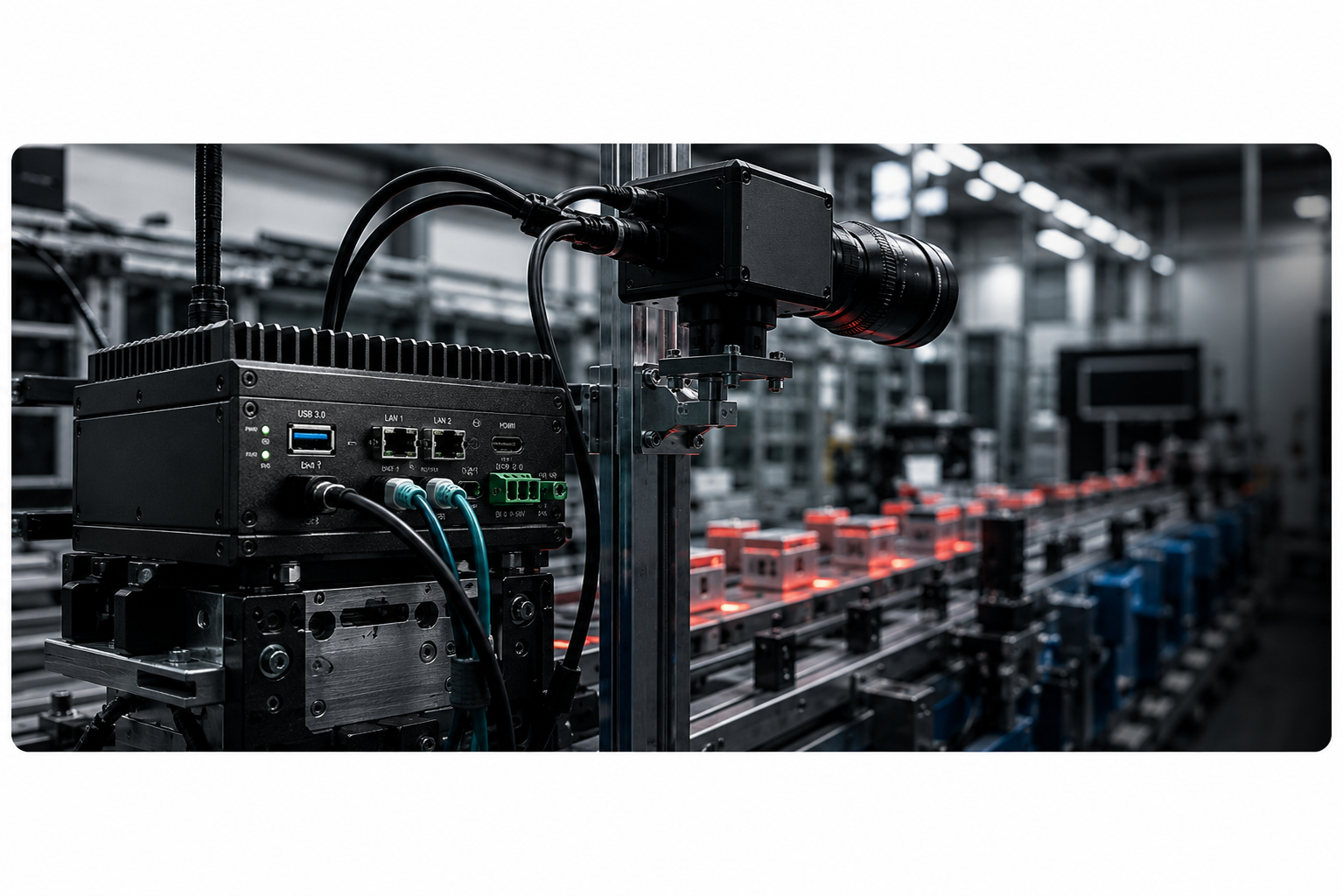
Physical-world systems continuously generate data through cameras, sensors, machines, vehicles and connected devices. The question is not only how to make sense of that data, but also where the intelligence should run.
For many applications, sending every signal to a distant cloud platform, waiting for processing and then returning a response is not always the most appropriate architecture. Some intelligence needs to operate closer to the system generating the data and executing the response.
That is where Edge AI becomes important.
Why the Edge Matters
Consider an industrial vision system inspecting products on a production line.
A camera may continuously generate images or video while the inspection system needs to detect defects and respond within the operating cycle of the process. Sending every frame to a remote service can increase network dependence and data-transfer requirements, while some applications may also have latency, privacy or availability constraints.
Processing part of the workload close to the camera or machine can allow the system to make local decisions while sending selected information to higher-level platforms.
This is not an argument for eliminating the cloud. It is an architectural decision about placing intelligence where it can operate effectively.
What Is Edge AI?
Edge AI combines local or near-source computing with AI inference so that data can be processed closer to where it is generated.
Sensor / Camera → Edge Compute → AI Inference → Local Decision → Action
The edge system may still communicate with cloud or enterprise platforms for functions such as centralized monitoring, historical analytics, model management, long-term storage and fleet or device management.
Edge and cloud are complementary parts of the same system architecture.
Why Move Intelligence Closer?
Latency. Some physical processes require a response close to the time an event occurs. Local inference can reduce dependence on a remote processing round trip.
Bandwidth. Cameras and high-frequency sensors can produce substantial data. Processing locally can allow systems to transmit results, events or selected data instead of every raw input.
Resilience. Local capabilities can allow selected functions to continue when cloud connectivity is intermittent, constrained or unavailable.
Privacy. Applications may benefit from processing sensitive raw information locally and sharing only the information required by upstream systems.
Operational control. Edge systems can connect directly to machines, controllers, robots and other devices, allowing intelligence to participate more closely in operational workflows.
Edge Intelligence Across Physical Systems
----------------------------------------------------------------------- Environment Edge Intelligence Example
----------------------------------- ----------------------------------- Industrial Intelligence Local visual inspection, anomaly detection and machine monitoring
Intelligent Mobility In-vehicle perception and intelligent vehicle functions
Physical AI Local perception, planning support and interaction with robots or autonomous machines
Smart Environments Occupancy, safety, energy and environmental intelligence -----------------------------------------------------------------------
The applications differ, but each has the same architectural question: which decisions need to happen close to the physical system, and which capabilities belong at a higher-level platform?
A Practical Edge-to-Cloud Architecture
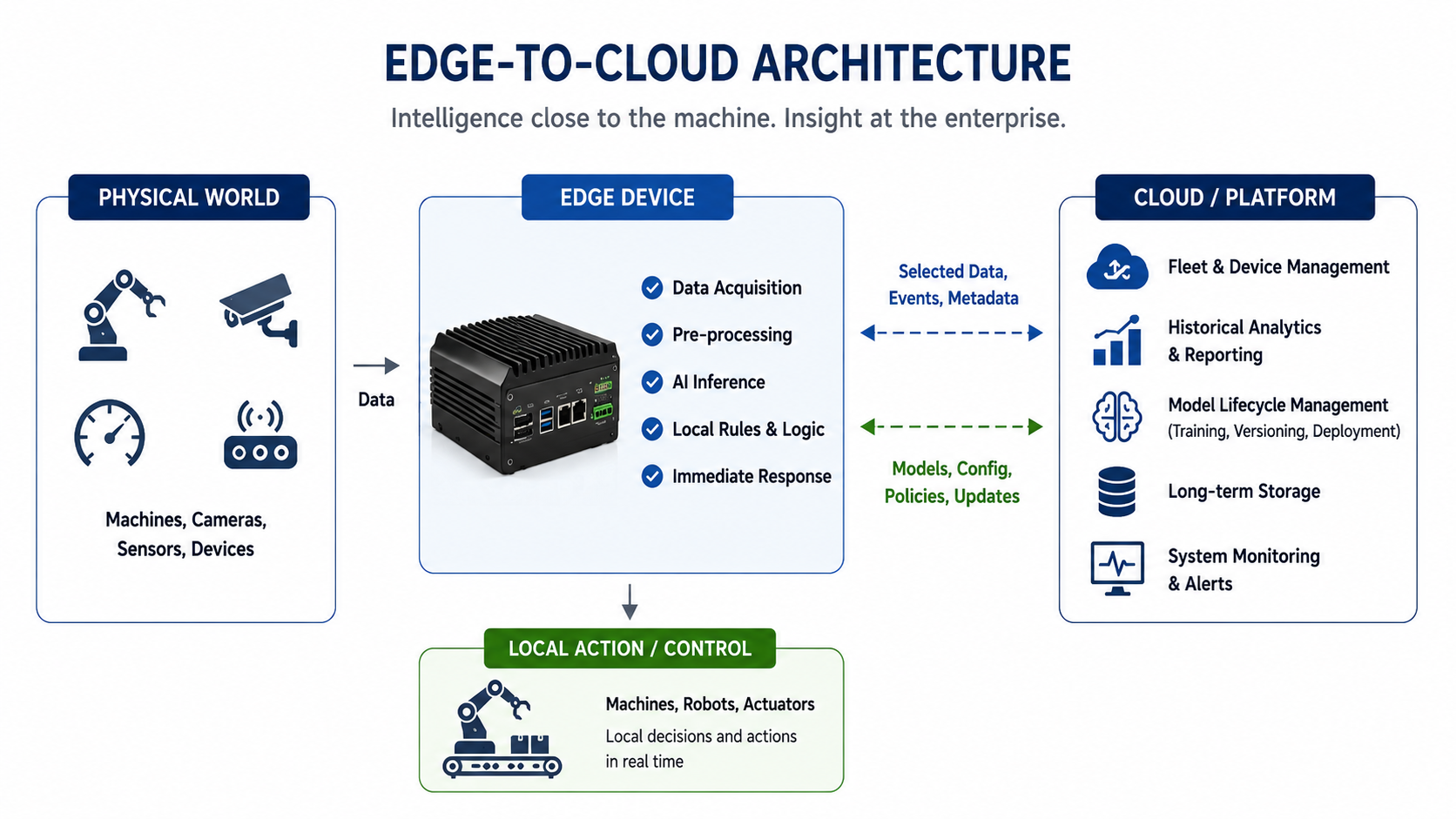
This distribution allows immediate functions to remain close to the physical process while higher-level capabilities can operate across devices, sites or longer time horizons.
Edge AI Is Also a Hardware Problem
An AI model that performs well on a powerful development workstation is not automatically suitable for a production edge device.
Edge deployment introduces trade-offs across:
Model ↔ Compute ↔ Memory ↔ Power ↔ Thermal ↔ Cost ↔ Latency
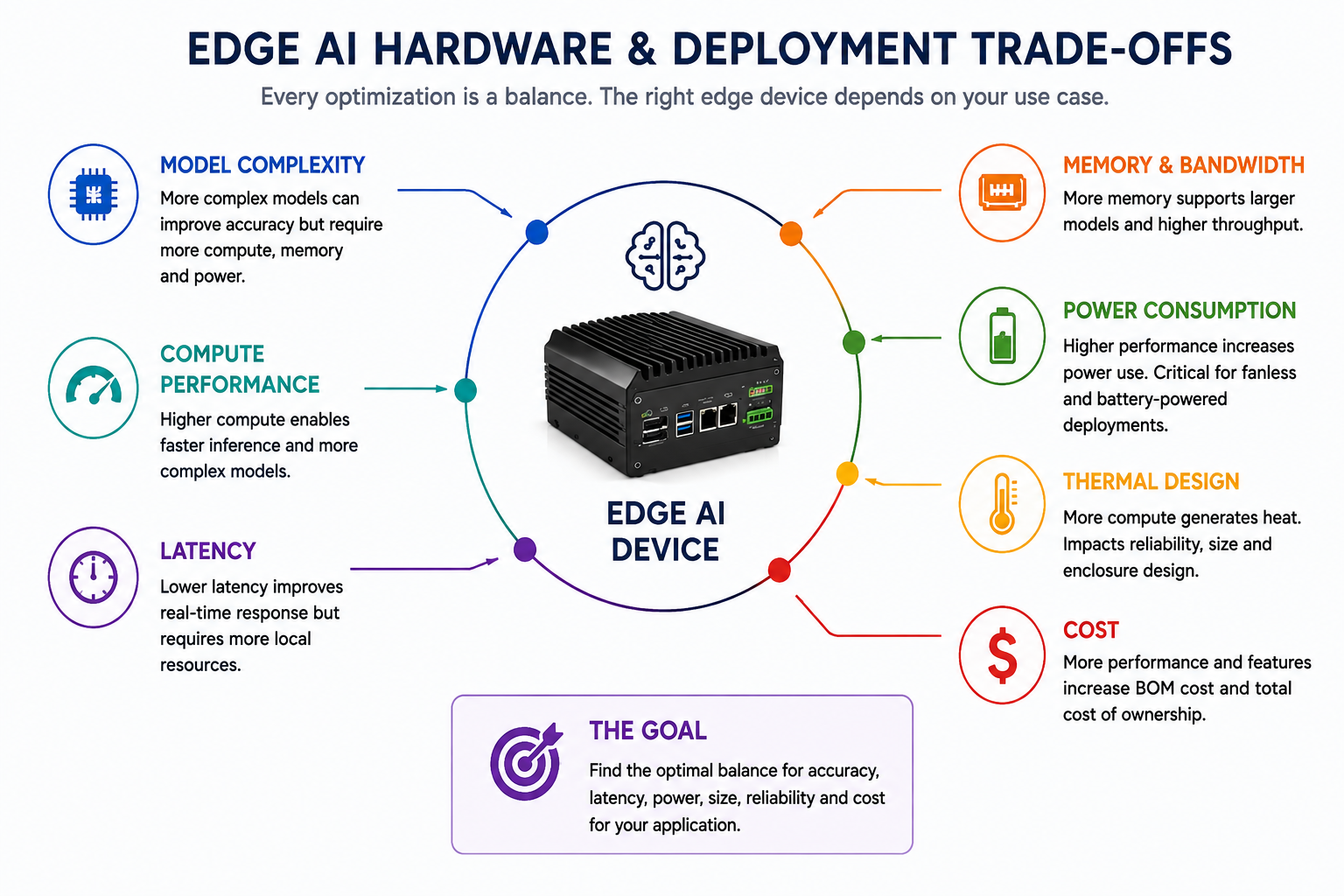
Engineering work may therefore include:
- Model optimization and quantization
- Hardware acceleration
- Memory and compute optimization
- Power and thermal management
- Device lifecycle and maintainability
- Deployment and update strategy
- Monitoring model and system behavior in production
Choosing where inference runs is therefore both an AI architecture decision and a systems-engineering decision.
Computer Vision at the Edge
Computer vision illustrates the value of edge intelligence particularly clearly because cameras can generate continuous, high-volume data streams.
Camera → Frame / Video Stream → Edge Vision System → Detection / Classification / Inspection → Decision → Reject / Alert / Track / Control
A local vision system can process incoming frames and forward selected events, results or evidence to upstream systems instead of requiring every frame to be processed remotely.
In an industrial setting, this can connect perception directly with quality inspection, process monitoring or machine workflows. Similar patterns can appear in robotics, mobility and smart environments.
The Edge Does Not Eliminate the Cloud
Treating edge and cloud as competing architectures oversimplifies the problem.
Edge systems are well suited to capabilities such as:
- Immediate inference
- Local decision-making
- Real-time interaction with devices
- Local pre-processing
- Operation under constrained connectivity
Cloud or centralized platforms remain valuable for:
- Long-term analytics
- Centralized monitoring
- Fleet and device management
- Model lifecycle and distribution
- Historical storage
- Cross-device and cross-site intelligence
The architectural question is not "edge or cloud?" It is "which intelligence belongs where?"
Designing Distributed Intelligence
A useful physical-world AI architecture distributes responsibilities according to the needs of the system.
A safety- or time-sensitive response may need to remain local. A historical trend may be better analyzed centrally. A vision model may run on an edge accelerator while model versions and device health are managed from a platform. Selected data may move to the cloud while raw high-volume streams remain local.
There is no single edge architecture that fits every application. The right design depends on latency, bandwidth, privacy, compute, power, cost, reliability, security and operational requirements.
The goal is not to move everything to the edge. The goal is to place each capability at the most appropriate layer of the system.
Intelligence Where It Matters
Physical systems need to sense their environment, understand what is happening, determine what should happen next and translate that decision into action.
Edge AI makes it possible to place parts of that intelligence closer to the cameras, sensors, machines, vehicles, robots and environments producing the data.
Cloud platforms continue to provide capabilities that benefit from centralized compute, coordination, management and longer-term analysis.
The future of physical-world AI is therefore unlikely to exist entirely at the edge or entirely in the cloud.
The engineering opportunity lies in distributing intelligence across the system --- placing each capability where it can operate most effectively.